What 7th graders learn in math (and how to check their homework)
The 7th grade math all 51 US standards agree on, what the year is made of, and a ten-second way to check each kind of homework problem without redoing it.
By the Kneade team · · 4 min read
The short answer
7th grade is the year arithmetic turns into algebra. In every US state it covers negative-number arithmetic, proportions and percent, two-step equations and inequalities, and probability.
51
grade 7 standards read, every state plus DC
8 of 12
core topics taught in all 51
39
skills in an average state's 7th grade
1 in 4
of those skills are data and probability
The year at a glance
Every 7th grade topic, a typical problem, and how many of the 51 standards teach it this year.
All 51
Operations with negative numbers
-3 - (-5) = 2
All 51
Proportional relationships
4 for $6, 10 for ?
All 51
Percent
25% off $40
All 51
Two-step equations
3x + 4 = 19
All 51
Inequalities
-2x > 8
All 51
Probability
P(sum of 7)
All 51
Samples and populations
30 of 600 kids
All 51
Area, surface area, volume
box 2 × 3 × 4
50 of 51
Simplifying expressions
2(x + 3) + 4x
50 of 51
Scale drawings
1 in = 5 ft
50 of 51
Circles
area, r = 6
44 of 51
Angle relationships
35° + ? = 180°
The gaps are timing, not omissions: Virginia splits circles across 6th and 8th grade, and most of the seven states without a 7th grade angle standard teach it in 8th.
Outside the US? The same year is Grade 7 in Canada (Secondaire 1 in Quebec), Year 7 in Australia, Year 8 in England, Wales and New Zealand, Year 9 in Northern Ireland and S1 in Scotland. We read those curricula too, and the core is much the same: negative numbers, proportions and equations.
What the year is made of
Figure 1
Share of 7th grade skills by area
Average of 51 standards. Data and probability, the part most parents remember least, is a quarter of the year.
44%
26%
17%
14%
Numbers, ratios and percent43.9%
Data and probability25.7%
Geometry and measurement16.5%
Expressions and equations13.9%
Source: Kneade analysis of the 2026-27 grade 7 math standards of the 50 states and DC
Why 7th grade feels different
-3 - (-5) = 2
Numbers go below zero
Subtracting can make a number bigger, and multiplying by a negative flips the sign.
3x + 4 = 19
The unknown gets a letter
A 6th grader sees x + 5 = 12. A 7th grader needs a method, and the method is the lesson.
It is also when many parents stop being able to help: today's methods differ from the ones we learned. You don't need the method, though. You need a way to check the answer.
Check any homework problem in ten seconds
Equations: put the answer back in
Their work
3x + 4 = 19
x = 5
Your check
3 × 5 + 4
= 19
Both sides match. Works for every equation this year.
Inequalities: test inside and outside
Their work
-2x > 8
x < -4
Your check
x = -5: 10 > 8 yes
x = 0: 0 > 8 no
Right. If it says x > -4, the sign wasn't flipped.
Negatives: tell it as a story
Their work
-3 - (-5) = 2
Your check
owe $3, a $5 debt
cancelled: $2 ahead
Story agrees. If it doesn't, check the signs first.
Percent: estimate with 10%
Their work
25% off $40
= $30
Your check
10% = $4
25% ≈ $10, $40 - $10
Lands on $30. An answer of $10 forgot to subtract.
Proportions: bigger or smaller?
Their work
4 for $6
10 for $15
Your check
more than $6? yes
less than $20? yes
In range. Most wrong answers fail this test first.
Circles: use 3 for pi
Their work
r = 6
area = 113.1
Your check
3 × 6 × 6 = 108
close to 113
Close enough. Near 38 means the circumference formula.
When the check says it is wrong
Don't reteach. Ask your child to walk you through the line where the answer changed and say why that step is allowed. Most of the time they find the mistake themselves, which is worth more than the right answer.
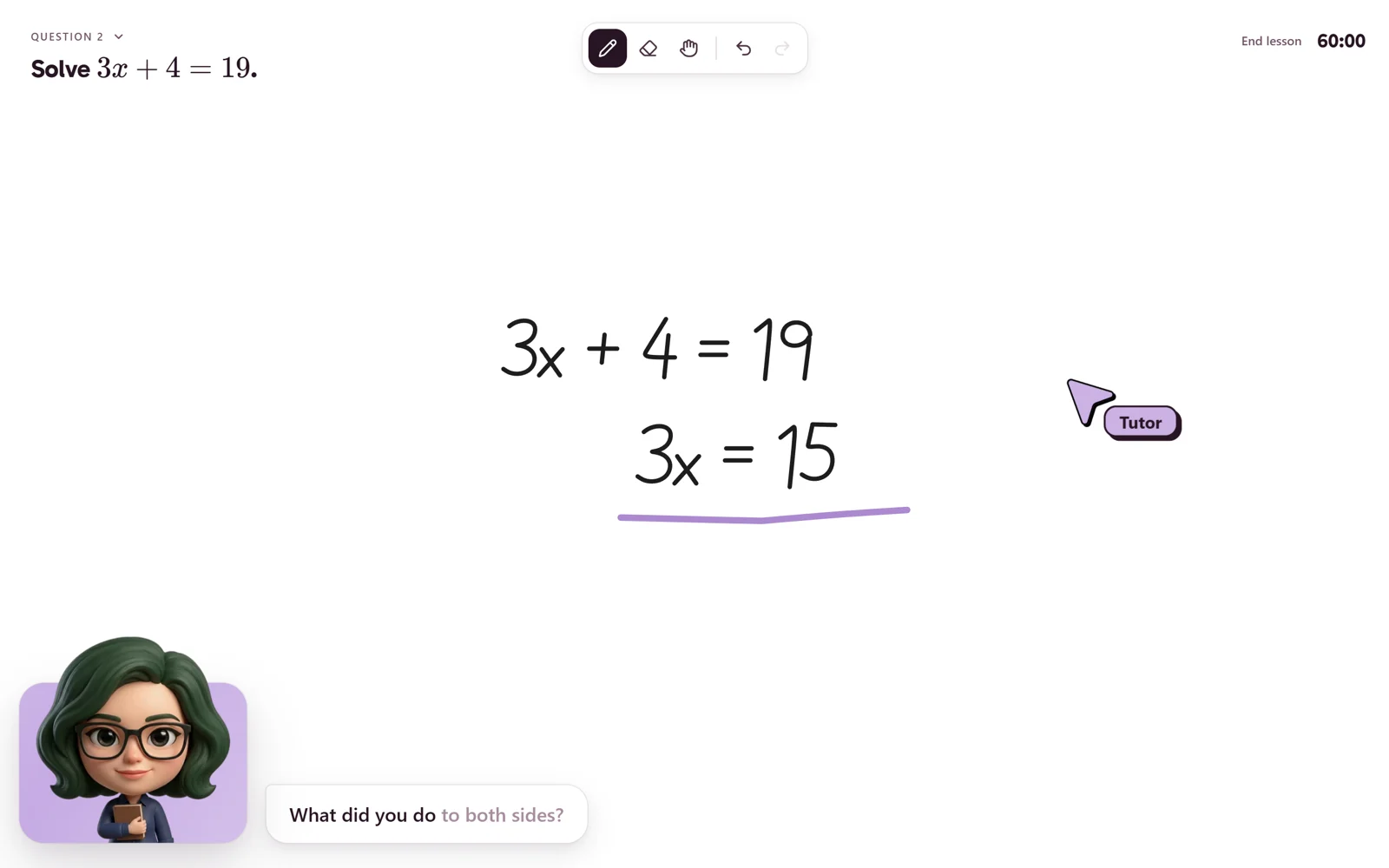
That is how a Kneade lesson works. Your child writes each line; when one needs a closer look, the tutor underlines it and asks about it out loud: "What did you do to both sides?"